
Nonprofit Basics: Nonprofit Accounting
Your fundraising team works hard to collect donations on behalf of your nonprofit’s mission. From the lengthiest of capital campaigns to the shortest giving day, you work hard on many initiatives to bring in money that will fund all of your organization’s expenses.
But just bringing in the money isn’t enough. This funding also needs to be allocated to various aspects of your mission and reported on according to the Generally Accepted Accounting Principles (GAAP). This allocation, reporting, and financial decision-making is where nonprofit accounting comes into play.
What is nonprofit accounting?
Nonprofit accounting is the process by which organizations plan, record, and report their finances on a regular basis. This process helps you make smart financial decisions so you can remain accountable to donors and meet your organization’s financial goals.
Nonprofits use a system of fund accounting rather than the traditional accounting system used by for-profit organizations. Fund accounting allows nonprofits to prioritize accountability to their donors over profitability for the organization.
Using this system is necessary because nonprofits sometimes receive gifts with restrictions placed on them by donors. Restricted gifts allow donors to ensure the funds they contribute are dedicated to the project they’re most interested in at your nonprofit. Your nonprofit is legally required to abide by these restrictions to stay accountable to the donors. Fund accounting makes it possible for nonprofits to organize this data and allocate funding accordingly.
What do nonprofit accountants do?
Nonprofit accountants ensure your nonprofit maintains the GAAP standards and help interpret financial data to make informed decisions at the organization. Specifically, they’ll help to review and reconcile your accounts, balance both sides of transactions, and compile statements and reports of your financial information.
Moreover, accountants help put together important financial preparations at your organization. For example, they help your nonprofit prepare:
- Your budget. Your accountant will use information from previous years’ fundraising strategy and your past expenses to determine your budget for the coming year. This budget typically contains conservative numbers to help the organization maintain financial stability and provide some flexibility for unexpected expenses.
- Audit materials. According to Jitasa’s nonprofit audit guide, some organizations have it in their bylaws that they need to complete an annual audit of their finances. Others may be required to do so by the state or federal government. Your accountant will pull your reports and ensure all financial information is complete and accurate for this auditing process.
- Tax forms. Although nonprofits don’t pay taxes, they still have to file annual tax forms. Your nonprofit accountant will compile your financial information for your Form 990 and any other required tax information to provide to the IRS.
All of this preparation requires intimate knowledge of your organization’s financial systems as well as the ability to read and understand all of your financial data. While very small organizations often rely on their executive members to accomplish these tasks, mid-size to large nonprofits often prefer to outsource their accounting needs or hire an internal accountant.
What are the types of reports used in nonprofit accounting?
In addition to everything listed above, accountants are also responsible for pulling together statements and reports of your financial data from your accounting software, whether that’s a dedicated fund accounting solution or a spreadsheet.
Let’s explore these reports further.
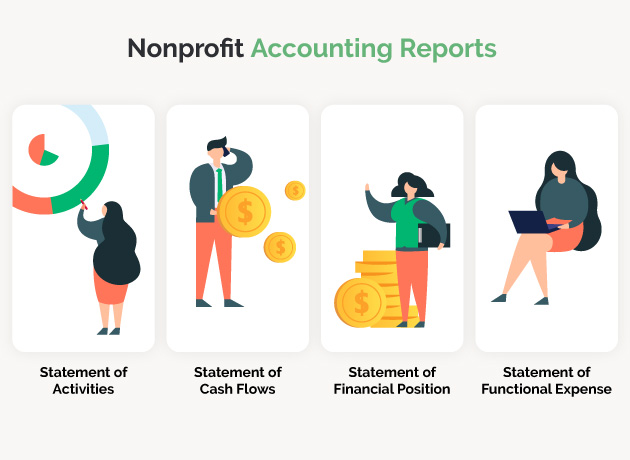
Statement of Activities
The nonprofit statement of activities is parallel to a for-profit’s income statement. This document lays out the organization’s revenue and expenses for the year in rows, then organizes each by restriction in the columns. The statement of activities categorizes the revenue and expenses, allowing the nonprofit accountant to analyze that data more effectively and review the organization’s net assets.
Statement of Cash Flows
Your statement of cash flows shows how cash moves in and out of your organization. This statement breaks down cash flow into three categories of activities: operating, financing, and investing. This way, you can see how your organization receives and uses money from fundraising, grant-seeking, and investing.
Statement of Financial Position
Your nonprofit’s statement of financial position is also known as your nonprofit balance sheet. This statement shows the financial health of your nonprofit by laying out your assets, liabilities, and net assets. When your net assets are positive, your organization is likely in a generally positive financial position, while having negative net assets means you likely have some financial reorganizing to do.
Statement of Functional Expenses
The statement of functional expenses breaks down your nonprofit’s expenses, organizing them by how they were used at the organization. There are three function categories this statement uses to organize expenses: program, administrative, and fundraising. The report is useful when it comes time to fill out your nonprofit’s Form 990, which organizes expenses in the same way.
What are nonprofit tax requirements?
Your accountant will also help your organization comply with federal and state tax requirements. While state tax requirements differ depending on the state in which your nonprofit is registered and operates, the federal requirements are similar between organizations.
Nonprofit accountants help organizations with forms such as the:
- Form 990. Small nonprofits with less than $50,000 in gross receipts may file the shortest version of the Form 990, the 990-N. Meanwhile, mid-sized organizations (with less than $200,000 in gross receipts) file the 990-EZ, and larger organizations file the full Form 990. This form is where you lay out your nonprofit’s expenses, revenue, executive salaries, and board members to ensure financial transparency with the IRS.
- Form 1099. Your nonprofit issues 1099s for contract workers who are paid at least $600 for the services they provide to your nonprofit. This helps those non-employee contractors to complete their own tax forms. To issue this form properly, your nonprofit needs to collect a W-9 from each contractor to outline basic tax information. Collect this form early in your relationship so you’re sure you have everything you need when it comes time to issue the 1099.
Tax season can be a stressful time for anyone, but for a nonprofit professional who already wears many hats, it can be closer to a nightmare. That’s why nonprofits frequently rely on an outside accountant to help organize and report their financial information for taxes.
Other Resources to Explore
Nonprofit Basics – Learn more nonprofit management essentials by exploring other expert resources.
Nonprofit Form 1099 Guide – Your organization needs to issue 1099s to any contractors you work with at the beginning of each year. Learn more about how and when to issue these tax forms.
Corporate Matching Gift Programs – Nonprofit accountants have more flexibility when setting your nonprofit’s budget if you maximize your fundraising efforts. See how corporate matching gifts can help you maximize your fundraising strategy.